How to follow up on a quote: a contractor’s guide
To follow up on a quote, reply in the original email thread, name the job, and ask one clear question about the customer’s next step. Use any follow-up date you agreed with them; if you didn’t agree one, choose a short gap that gives them time to review. After each conversation, record the outcome, who will act next and the next follow-up date.
How to follow up on a quote without being pushy
A useful quote follow-up helps the customer make a decision: it answers a scope question, checks their timing or confirms whether the work is still going ahead. Keep the message short enough that they can answer it between other tasks.
Before sending, check three things:
- The latest reply: has the customer already asked you to wait, declined, or accepted?
- The quote version: are you discussing the current scope and price?
- The next question: what do you actually need to know—whether they received it, whether the scope fits, or when they expect to decide?
Reply in the existing thread so the customer can find the quote. If you need to resend it, use the current document or link from your quoting tool.
Send a first message that names the job
Use this when you’ve sent the quote and haven’t heard back. Replace the bracketed details before sending.
Subject: Re: Quote for [job]
Hi [name],
I’m checking that you received the quote I sent on [date] for [job]. Is there anything in the scope you’d like me to clarify before you decide?
Thanks, [your name]
If the customer already confirmed receipt, skip that question. Ask about the detail they were considering instead: “Does the revised door specification cover what you wanted?” is easier to answer than “Any thoughts?”
Use the communication channel you’ve already been using with the customer. Don’t send the same nudge by email, text and phone on the same day just because you haven’t had a reply.
When should you follow up on a quote?
Follow up on the date the customer agreed to, or after the review period they requested. If there’s no agreed date, a first check after a few business days is a practical starting point, rather than a fixed rule for every job. An urgent repair and a renovation planned for next season need different timing.
At the end of a conversation, ask: “When would be useful for me to check back?” Put that date in your quote list immediately.
If the quote has a genuine expiry date, mention the date already written in it and explain what needs checking afterwards. Don’t invent a deadline or imply a start date is reserved when it isn’t.
Turn a reply into a specific next action
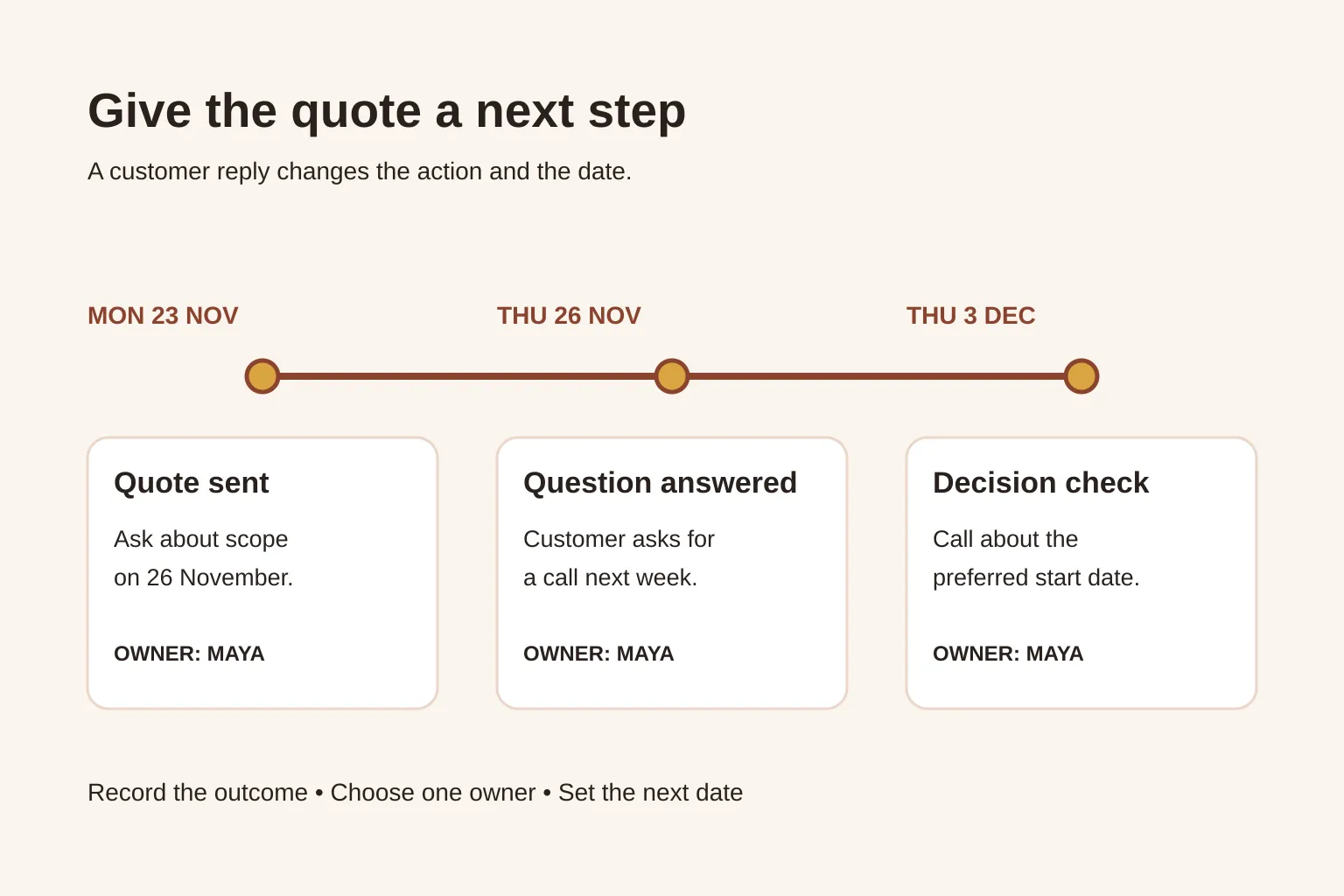
Say Maya runs a small electrical business and sends a kitchen-work quote to Jordan on Monday, 23 November 2026. The following dates show one possible sequence, not a schedule every quote should follow.
| Date | What happens | What Maya records |
|---|---|---|
| 23 November | Maya sends the quote and plans to check whether the scope is clear. | Stage: Sent. Owner: Maya. Action: Email about scope. Due: 26 November. |
| 26 November | Jordan asks whether the quoted work includes the under-cabinet lighting. Maya answers using the quote’s scope. Jordan asks for a call next week after reviewing the project budget. | Stage: Decision pending. Owner: Maya. Action: Call about preferred start date. Due: 3 December, agreed with Jordan. |
| 3 December | Maya calls. Jordan says the renovation is on hold and doesn’t want further follow-up for now. | Outcome: On hold, customer requested no follow-up. Remove the active reminder and keep the conversation history. |
The important change happens on 26 November: Maya replaces the old reminder with the action Jordan requested. Leaving “Email about scope” overdue would make the list misleading even though the conversation had moved forward.
By the review on 23 December, this quote should no longer appear among calls due today. If Jordan returns later, Maya can review the scope, pricing and availability before treating the old quote as current.
Use a second message to clarify timing
If the first message gets no reply, make the next one about whether the job is still being considered. Leave a reasonable gap based on the job and any timing the customer has shared.
Hi [name],
Are you still considering the quote for [job], or has the timing changed? If you’re waiting on another part of the project, let me know when you’d prefer me to check back.
Thanks, [your name]
If they raise a price concern, ask which part of the scope or budget needs discussing before offering a discount. Any changed scope should go back through your normal quoting process so both sides are looking at the same offer.
Close the follow-up loop when there’s no reply
Repeated reminders with no new information make more work for both sides. After unanswered follow-ups, send a short closing message and stop the active reminders unless the customer has requested a later check-in.
Hi [name],
I haven’t heard back about the quote for [job], so I’ll leave it with you and stop the follow-up reminders. If you’d like to revisit the work, reply here and we can check the scope and current availability.
Thanks, [your name]
Record “No response—follow-up closed” rather than “Declined.” Silence doesn’t tell you why the customer stopped replying. An accepted quote, a declined quote and a paused project should also have different outcomes in your records.
Keep the next call visible between jobs
A sent-quote list needs the customer and job, quote-sent date, stage, owner, next action and follow-up date. Review open quotes weekly and check due actions during the week. One named owner prevents two people from chasing the same customer.
You can start with the weekly open-quote review sheet and spreadsheet template. Use one row per sent quote, write “Call about preferred start date” rather than “Follow up,” and keep the quote itself in your existing estimating tool.